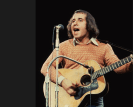
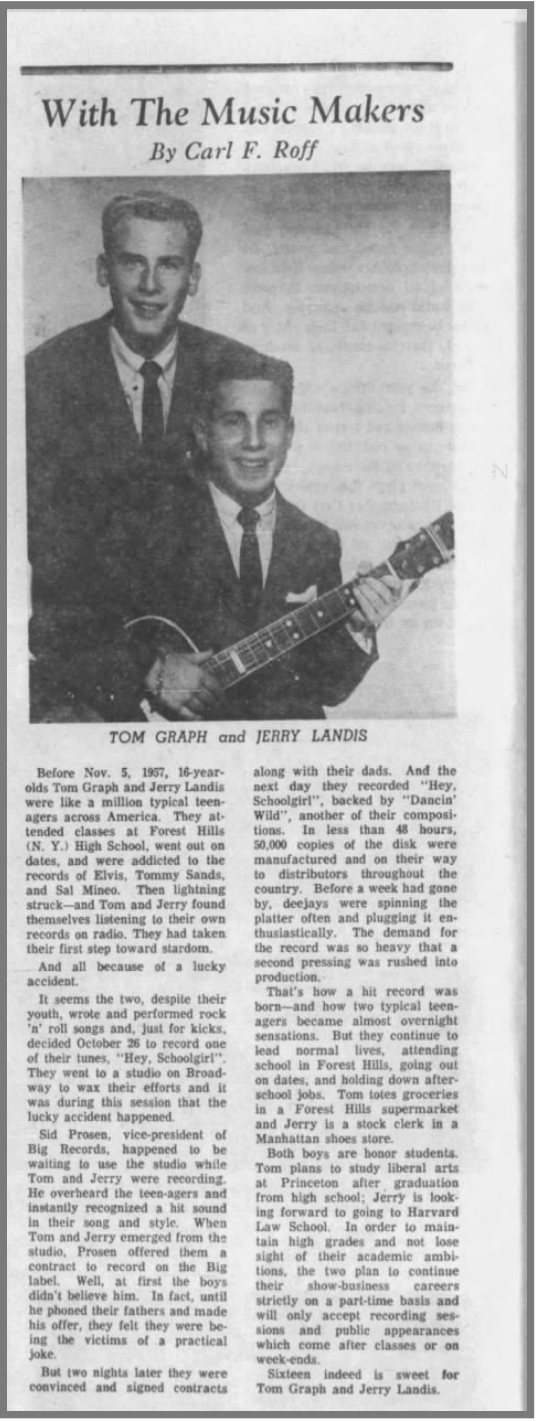
There’s a lot unknown about the recordings of Tom & Jerry. But this article in The Record of January 4th 1958 mentions that their hit single ‘Hey Schoolgirl’ was recorded on October 26 in 1957. And 3 days later ‘ Dancin’ wild’ followed.
There’s a lot unknown about the recordings of Tom & Jerry. But this article in The Record of January 4th 1958 mentions that their hit single ‘Hey Schoolgirl’ was recorded on October 26 in 1957. And 3 days later ‘ Dancin’ wild’ followed.
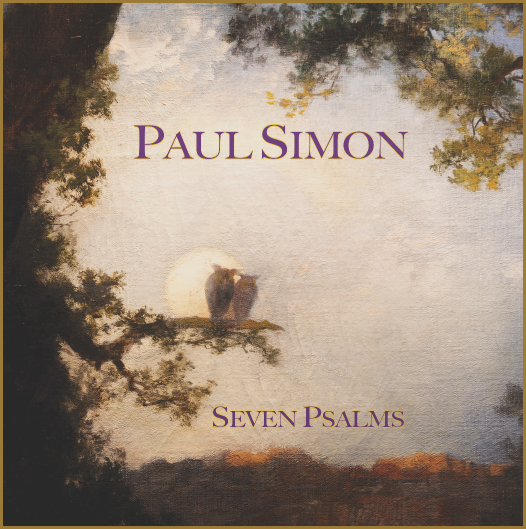
Paul Simon Confronts Death, Profoundly, on ‘Seven Psalms’
The 81-year-old songwriter ruminates on mortality, faith and meaning in an album that could be a farewell.
What do songwriters do when they feel death approaching? As time runs out, some choose to spend it by determinedly creating music to outlive them.
“Seven Psalms” sounds like a last testament from the 81-year-old Paul Simon. It’s an album akin to David Bowie’s “Blackstar” and Leonard Cohen’s “You Want It Darker,” which those songwriters made as mortality loomed; they each died days after the albums were released.
Their generation of singer-songwriters has dedicated itself to chronicling their entire lives, biographically and metaphorically, from youth through last words. “Blackstar” was turbulent and exploratory; “You Want It Darker” was stoically bleak. “Seven Psalms” stays true to Simon’s own instincts: observant, elliptical, perpetually questioning and quietly encompassing.
The album is constructed as a nearly unbroken 33-minute suite, nominally divided into seven songs that circle back to recurring refrains. It has places of lingering contemplation and it has sudden, startling changes; its informality is exactingly planned.
Simon begins the album in his most casual tone. Over calmly precise and rhythmically flexible guitar picking, he sings, “I’ve been thinking about the great migration.”
Almost immediately, it becomes clear that the migration is from life to death, a transition the singer is preparing to make himself. He’s thinking about time, love, culture, family, music, eternity and God, striving to balance skepticism and something like faith. “I have my reasons to doubt/A white light eases the pain,” Simon sings in “Your Forgiveness.” “Two billion heartbeats and out/Or does it all begin again?”
Simon’s songwriting has never been particularly religious. Over the years, he has drawn on gospel music for songs like “Bridge Over Troubled Water” and “Loves Me Like a Rock,” which bring religious imagery to secular relationships, and his 2011 album, “So Beautiful or So What,” had touches of Christian imagery — but also imagined “The Afterlife” as one last bureaucracy, where arrivals have to “Fill out a form first/And then you wait in a line.”
“Seven Psalms” is more humble and awe-struck. Its refrains return to, and work variations on, the album’s opening song, “The Lord.” As in the psalms of the Bible — which, as Simon notes in “Sacred Harp,” were songs — Simon portrays the Lord in sweeping ways: wondrous and terrifying, both protector and destroyer, sometimes benign and sometimes wrathful. The Lord, Simon sings, is “a meal for the poorest, a welcome door to the stranger.” Then he turns to naming 21st-century perils: “The Covid virus is the Lord/The Lord is the ocean rising.”
Much of the music sounds like solitary ruminations: Simon communing with his guitar, which has been the subtly virtuosic underpinning of most of his lifetime of songs. As his fingers sketch patterns, he latches onto melody phrases and then lets them go, teasing at pop structures but soon dissolving them. And around him, at any moment, sounds can float out of the background: additional supportive guitars, the eerie microtonal bell tones of Harry Partch’s cloud-chamber bowls, the jaunty huffing of a bass harmonica and, in the album’s final moments, the voice of his wife, Edie Brickell.
In the course of the album, Simon sings about personal distress and societal tensions. In “Love Is Like a Braid,” a song of gratitude and vulnerability, he sings, “I lived a life of pleasant sorrows until the real deal came/Broke me like a twig in a winter gale.” In “Trail of Volcanoes,” he juxtaposes youthful exploits with adult realities: “The pity is the damage that’s done/Leaves so little for amends”
Meanwhile, Simon’s tartly aphoristic side reappears in “My Professional Opinion,” a swipe at social media context collapse set to a country-blues shuffle. “All rise to the occasion/Or all sink into despair,” he sings. “In my professional opinion/We’re better off not going there.”
He ends the album — possibly his last — with a song called “Wait.” He protests, “My hand’s steady/My mind is still clear.” Brickell’s voice arrives to tell him, “Life is a meteor” and “Heaven is beautiful/It’s almost like home.” At the end, he harmonizes with her on one word, extended into five musical syllables: “Amen.” It sounds like he’s accepting the inevitable.
Paul Simon
“Seven Psalms”
(Owl Records/Legacy Recordings)
Jon Pareles has been The Times’s chief pop music critic since 1988. A musician, he has played in rock bands, jazz groups and classical ensembles. He majored in music at Yale
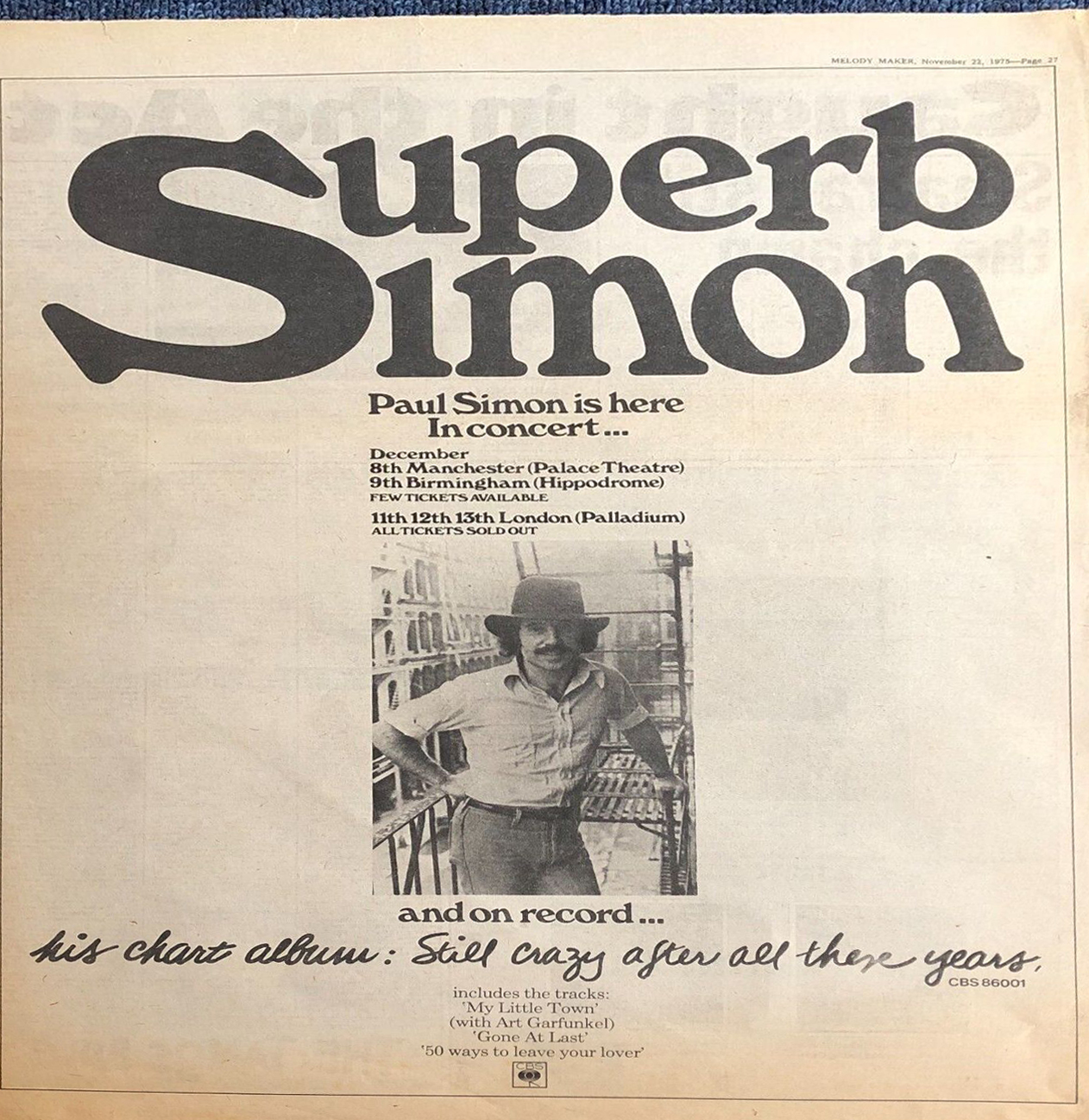
[With thanks to Roy for the advertisment]
Last month of 1975 brought Paul Simon to Europe to promote his latest album ” Still Crazy After All These Years”.
It brought him to the UK on:
1975-12-08 Manchester – United Kingdom Manchester Palace
1975-12-09 Birmingham – United Kingdom Hippodrome
1975-12-11 London – United Kingdom Palladium Theater
1975-12-12 London – United Kingdom Palladium Theater
1975-12-13 London – United Kingdom Palladium Theater
1975-12-27 London – United Kingdom Palladium Theater
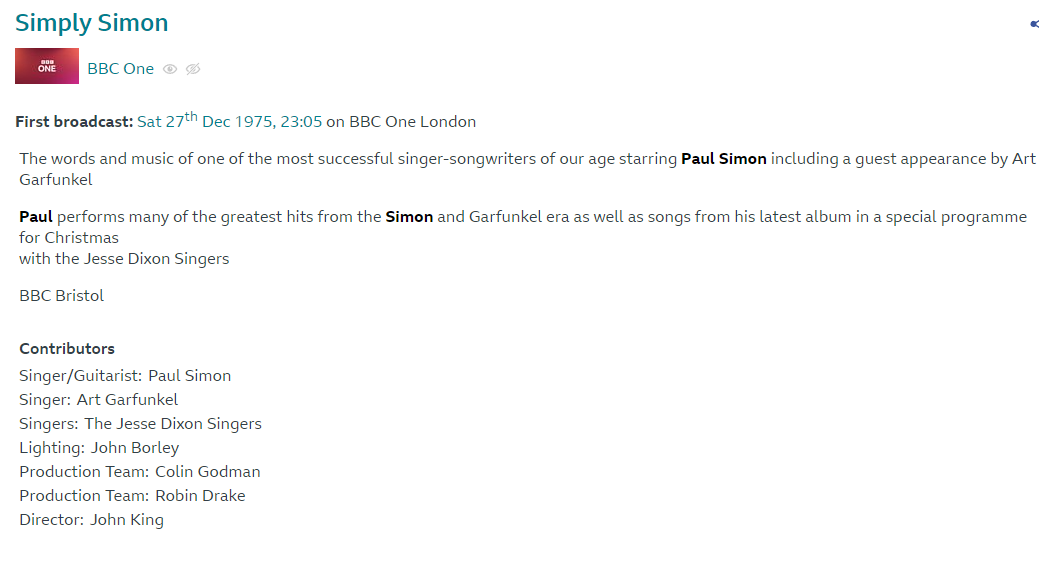
The last date was also the first broadcast of the BBC TV special ” Simply Simon ” and I am still not certain if this was recorded live at The Palladium or previously in studio.
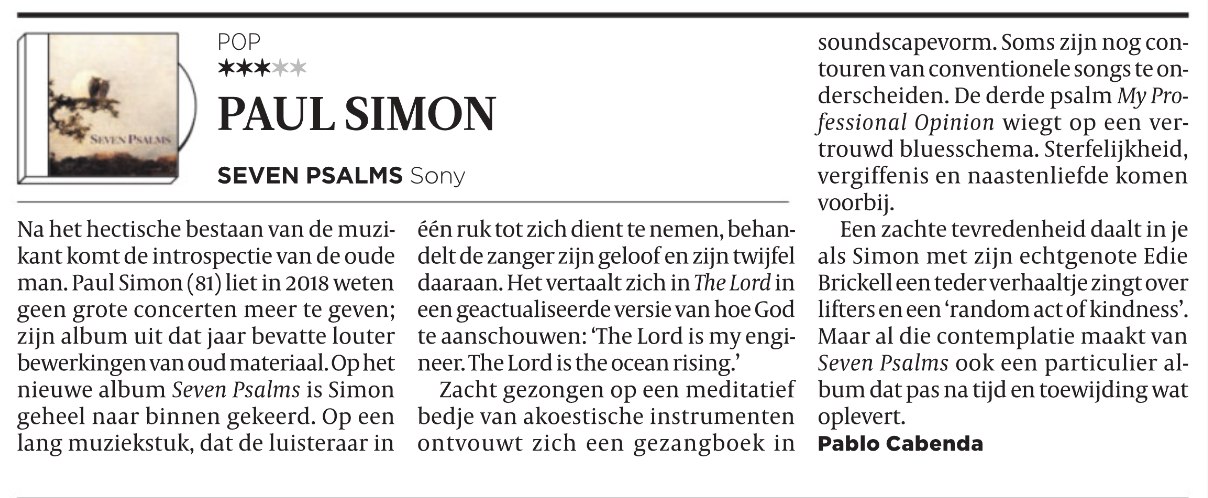
From Dutch to English with Google Translate:
After the hectic existence of the pop musician comes the introspection of the old man. Paul Simon (81) announced in 2018 that he would no longer give major concerts; his album from that year contained mere edits of old material. On the new album Seven Psalms, Simon has completely turned inward. On a long piece of music, which the listener has to absorb in one go, the singer deals with his faith and his doubts about it. It translates into The Lord in an updated version of how to see God now: ‘The Lord is my engineer. The Lord is the ocean rising.”
Sung softly on a meditative bed of acoustic instruments, a hymnal unfolds in soundscape form. Sometimes contours of conventional songs can still be distinguished. The third psalm My Professional Opinion rocks on a familiar blues scheme. Mortality, forgiveness and charity pass by.
A soft satisfaction sinks into you as Simon and wife Edie Brickell sing a tender story about hitchhikers and a ‘random act of kindness’. But all that contemplation also makes Seven Psalms a private album that only pays off after time and dedication [source De Volkskrant 2023 May 19, author Pablo Cabenda]
Coming this week:
In 1966 (February 12) Simon & Garfunkel appeared during a Winter Carnival show at University of Massachussets together with The Four Seasons and The Rovin’ Kind in The Curry Hicks Cage.

As so often Art Garfunkel’s name was misspelled, this time not as Garfunkle, but as Garfunckle.
Two great “surprise” performances at the Newport Folk Festival this year.
Saturday July 23: Paul Simon.
This is what Paul Simon says about it on the official site:
The atmosphere at Newport Folk Festival and the spirit of the folk community yesterday was incredibly joyful. Thank you Jay Sweet for running such a great festival, and thanks to Chris Tetzeli for all of his patience and energy to make this happen.
What an absolute pleasure to work with Nathaniel Rateliff and his incredible band (Luke Mossman, Joseph Pope III, Pat Meese, Andreas Wild, Jeff Dazey, Daniel Hardaway, Mark Shusterman). Nathaniels curation of my music and all of the artists he selected to participate was overwhelming. My sincere thanks to those artists for lending their talent and time to come and perform my songs.
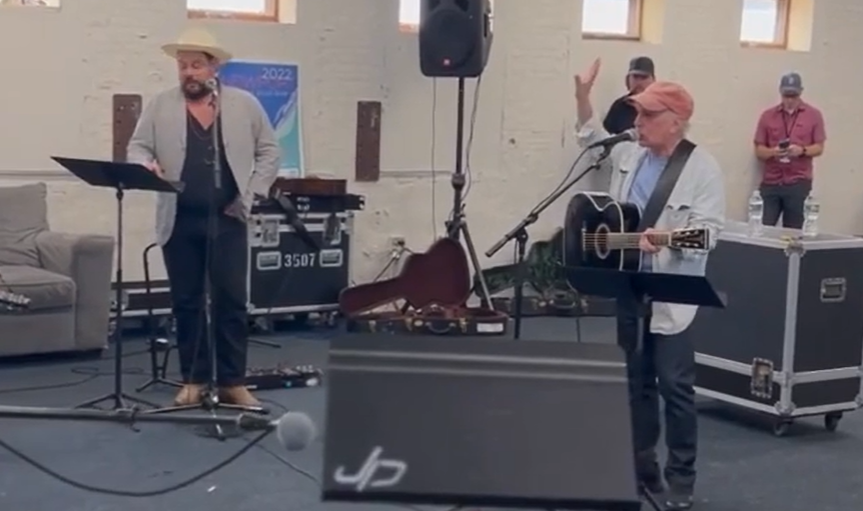
After Nathaniel Rateliff and his band played a couple of Paul Simon songs as tribute to the singer/songwriter he was invited on the stage.
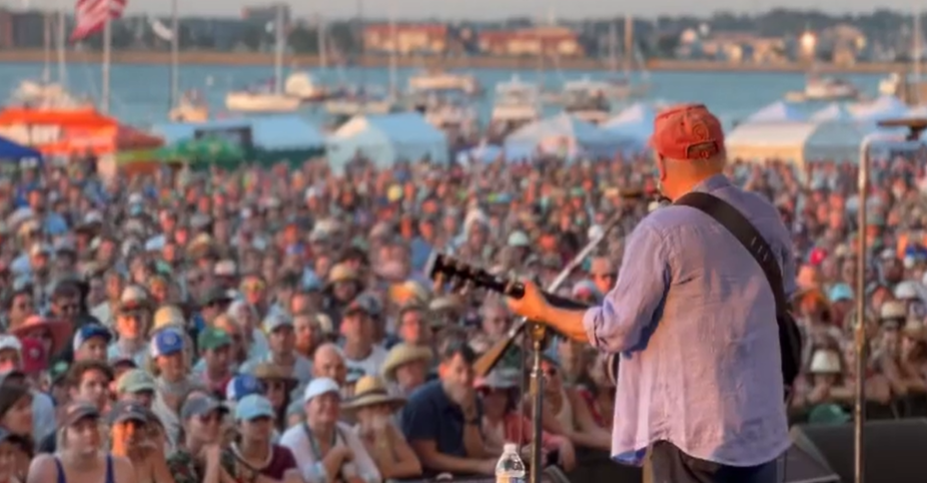
He played a short set:
“American Tune” was sung by the wonderful singer Rhiannon Giddens, accompanied by Paul Simon. Rhiannon played an almost haunting part on her banjo. This might be a good reason for Paul to record this song again sometime with Rhiannon. And what a great voice Rhiannon has.
Rehearsing with Rhiannon:
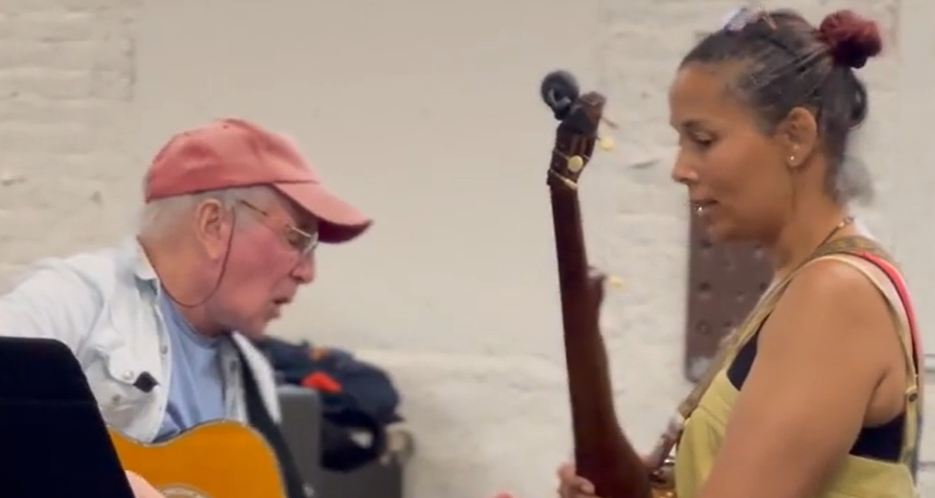
The lyric was also partly slightly altered in: “We didn’t come here on the Mayflower, we came on the ship in a bloody mood”.
Wonderful to see Paul perform again.
Rehearsing with the band:
The next day brought an even bigger surprise, knowing she has been very sick the last years: Joni Mitchell. Her set, sitting on big chair, lasted for almost an hour. Go see it at youtube.
Have been able to collect some more folkclub venues where Paul Simon played during 1964 / 1965. Many were found on the MUDCAT.org platform where those who visited the clubs in the mid-60’s share their memories. Not always an exact year or date could be found to be added.
Here are the new finds:
In 1965 Paul Simon played on July 13th at Exeter Jolly Porter Folk Club. The organisers had tried to get Donovan, “but he pulled out at the last minute so we got Paul Simon who we had never heard of. Until then there was the Dylan crowd and the traditionalists, somehow Paul united the two groups that evening and influenced both playing and song writing in the area” [Source: Dudley at Mudcat.org on Feb 20, 2011]
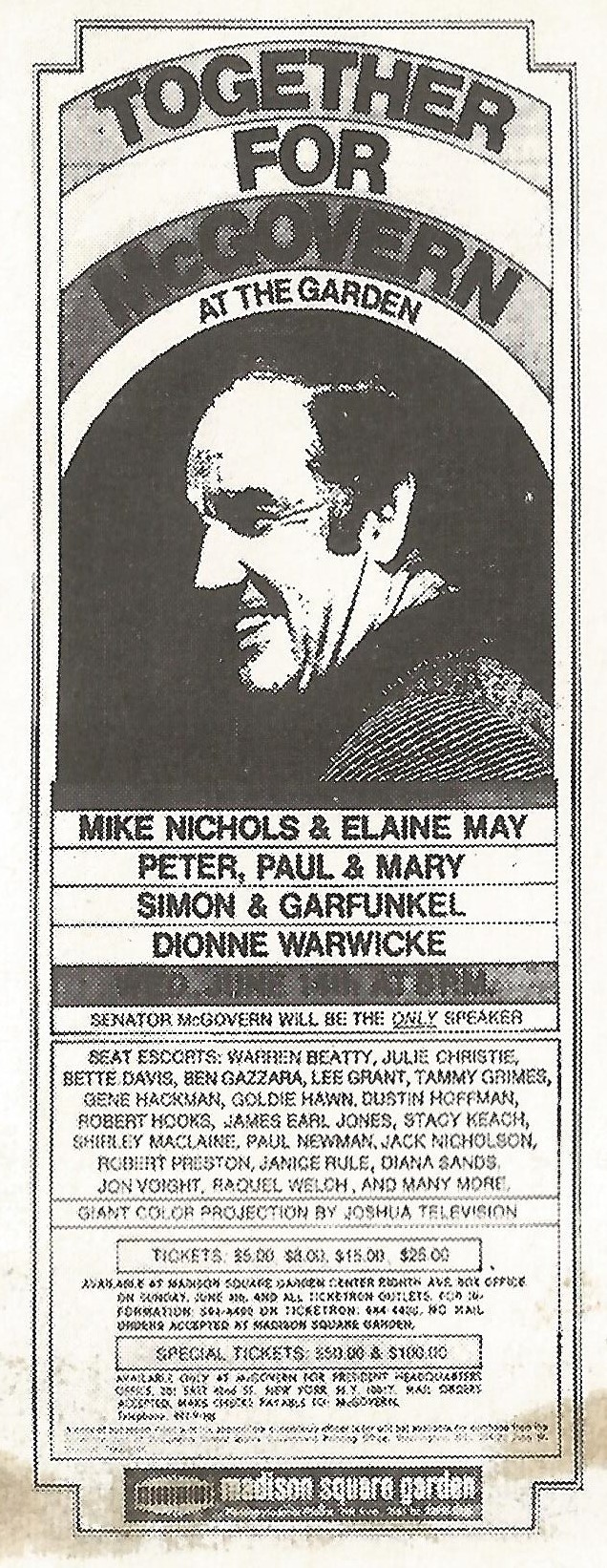
Not so long agao I was listening to the set Simon & Garfunkel played in 1972 in New York City at Madison Square Gardens.


They played on June 14th at the benefit show held for George McGovern’s campain to become America’s next president.
And now I found the advertisment for it “tucked away” in the cover of a Japanese 45rpm release:

1967-02-19 Towson, MD, Towson College, Stephens Auditorium (0300 pm show)
Simon & Garfunkel performed here during the closing day of “Sweetheart Weekend”. It was Bev Berlett Norwood who arranged as chairperson of the Student Government Association. that the duo performed at Towson College, she writes:
“As an executive board member of the Student Government Association of Towson College in the late 1960s, I served as the chairperson of the Special Events Committee. I was responsible for contracting speakers for lectures as well as for hiring performers for concerts and major dances. (Today, this is a full-time paid position.) In 1967, I booked Simon and Garfunkel for our Sweetheart Weekend Concert. They were phenomenal! I met with them prior to the concert, when they asked me specific questions about our college. They especially wanted to know what might trigger laughter and applause from the audience. Cleverly and inventively, they incorporated the information into their performance. I have so many fond memories of that day, as do so many others who attended the amazing concert! Our college president, Dr. Earl T. Hawkins, even thanked me personally and wrote in the college newspaper how I had arranged for Simon and Garfunkel to appear.”
Here’s the review of the Simon & Garfunkel performance:
By LARRY HORWITZ [source: Towson College, MD, Tower Light, February 24 1967]
Simon Says “Applaud. . And They Did”
Paul Simon and Art Garfunkel sort of breezed into Towson around two thirty last Sunday afternoon, an hour after the first students had queued up in front of the doors to Steph-en’s Auditorium. Paul Simon, a small dark-haired guy, began Picking out some stray notes on the piano while Art Garfunkel, a sensitive-faced frizzy-haired boy, unpacked a paisley tie and a pair of suede Beatle boots from a suitcase that had twenty or thirty airline check stubs tied to the handle. Meanwhile Stephen’s Auditorium was filling with students, all growing impatient as the scheduled hour for the start of the concert came and passed. The house lights dimmed, a Spotlight hung on the curtain’s edge, and somewhat humbly, With no introduction, the pair Walked onstage and moved right into their first song. From the very start the audience was with Simon and Garfunkel and the pair knew it; they performed well, happily, joking with one another and singing and playing with a very rew-laxed attitude. Paul Simon, twenty-four and a graduate of Queen’s College in New York, writes all of the songs that the pair record and perform. His writing is literate, meaningful and usually full of striking and sometimes poetic imagery. The first half of the concert showcased some of the pair’s most popular songs. After a twenty-minute intermission the boys came back onstage.
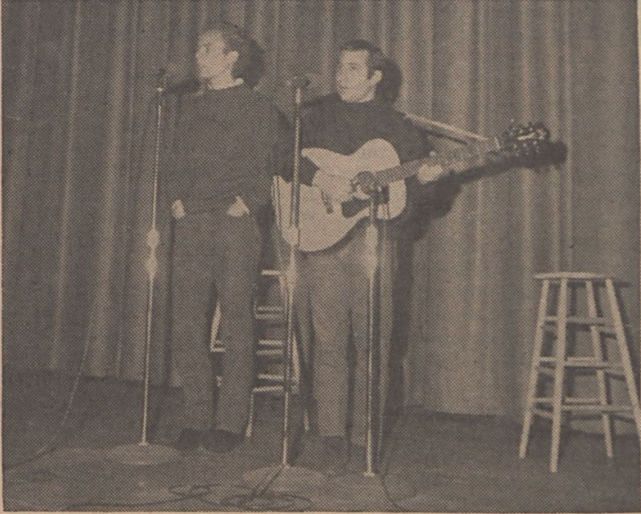
The relaxed mood, the assurance, the ease with which they performed to a college audience was aptly demonstrated by the fact that Paul Simon was cheerfully and unselfconsciously sucking on a grape lol-lipop which he lay on a table next to his 12-string guitar while he was singing. The second half seemed, if possible, better than the first. Nine consistently good songs were not enough for an enthusiastic aud-ience which brought the pair back for two encores. One song which brought peals of knowing laughter was “”The Zoo Song”” which included the line “”Hamsters turn on frequently”” and led Paul Simon to tell a satiric story about marijuana smoking in Darien, Connecticut. Still seeming humble the boys bowed one, twice and left for the downstairs dressing room amidst sustained applause.
Crowds of varied types assembled outside of the dressing room, after the Sunday afternoon concert of Simon and Garfunkel. There were half a dozen long tressed high school teeny-bop-pers and two rather loud members of the Hell’s Angels and the sportscoated student leaders and their hig-heeled dates and kids and faithful admirers and autograph seekers and photographers and simply curious types. All were allowed in the room, but only after the singers had been allowed to change and speak with some friends. Paul Simon, smoking filtertipped cigarettes and sitting on a table, signed autographs and shook hands while he spoke. “”The Beatles, I think they’re great. This is a nice school. I thought this was good, a good performance.”” Simon was smiling, being nice to everyone, Comment being extremely courteous, sign-ing autographs, being friendly, personable, speaking very quiet-ly and answering a question about the continuity of his song writing, a question about the message or theme he’s trying to get across. “”I don’t know if it’s so much a conscious thing, but we’re dealing with things that concern us. Things like alienation and hypocrisy and love and communication, and, of course, the lack of it.” A strange-looking boy with a moustache asked about the image of Simon and Garfunkel: Simon answered gently, “”it’s really us; we act the same way offstage as on. If we didn’t we wouldn’t be honest.”” Someone challenged the performance and asked why they only told two jokes, Sinion smiled, “”We’re not comedians; if something strikes me as funny or absurd, I mention it. Nightclubs are alien to me.”” “”No, I don’t think too much of Donovan.”” “”I like Bach, the Impressionists, Indian sitar music.”” Art Garfunkel came quickly into the room, trying to hurriedly pack, and was forced to pose for several pictures. He too was quiet and sensitive but spoke faster, and slightly more candidly than his partner. “
“Yes, I’ll eventually teach, I’m not at all sure what level,”” said the twenty-five year old, who is at work toward his Ph.D. from Columbia. A boy in a red sweater asked about the apparent one-sidedness of the arrange-ment; Simon does all the writ-ing.”Yes, but there are two ways in which you can express yourself; I lack the skill of writing but Paul is providing material with which I agree and can express through speech. Paul’s songs, the themes of. his songs, are not to be argued with, they’re not for agreeing with or disagreeing with. They are questions, examinations of an area which troubles us, and probably everyone.”” Do they ever disagree on a song by Simon, “”Rarely. There isn’t any discontinuity; we both are con-cerned with the same things and Paul just writes it well, some-thing I can’t do. Sometimes he shows me a song which I don’t like musically, but never one I don’t like from any other basis.”” The room grew pretty active as their manager began to rush them off to meet a plane. It seemed as though they would have been content to stay and talk with the kids for a while longer. It seemed as though Simon and Garfunkel enjoyed speaking with these people to whom their music speaks so ef-fectively.
[Source: Tower Light, Towson College, February 24, 1967]
 Paul Simon - 'Time it was...it was'