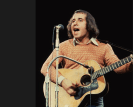
![By Nationaal Archief, Den Haag, Rijksfotoarchief: Fotocollectie Algemeen Nederlands Fotopersbureau (ANEFO), 1945-1989 - negatiefstroken zwart/wit, nummer toegang 2.24.01.05, bestanddeelnummer 919-3036 (Nationaal Archief) [CC BY-SA 3.0 nl (http://creativecommons.org/licenses/by-sa/3.0/nl/deed.en)], via Wikimedia Commons](https://i0.wp.com/hastingsonlinetimes.co.uk/hottie/wp-content/uploads/2015/08/Paul-Simon.jpg)
Bexhill Bound: Paul Simon in Sussex
In this article reprinted with the kind permission of The Stinger, Stuart Huggett recalls Paul Simon’s visit to Bexhill as a budding but unknown folk singer back in the 1960s.
Fifty years ago this August, Paul Simon performed at the De La Warr Pavilion’s Folk Music Festival, appearing on the Bank Holiday Monday bill in front of, as fellow guest Ralph McTell recalled during a recent concert, “Six people asleep in deck chairs.” If the festival was poorly attended at the time, in retrospect the bill is mouth-watering, with Simon and McTell (then known as Ralph May) joined by Shirley Collins and Davy Graham, Ian Russell and Rob Edwards.
That Simon was on the De La Warr bill may look surprising today but more so is the fact that this wasn’t even the first time the New York musician had visited the area. He’d previously made his way to Sidley and played at The New Inn’s folk club, sometime in 1964 (and possibly other local pubs too).
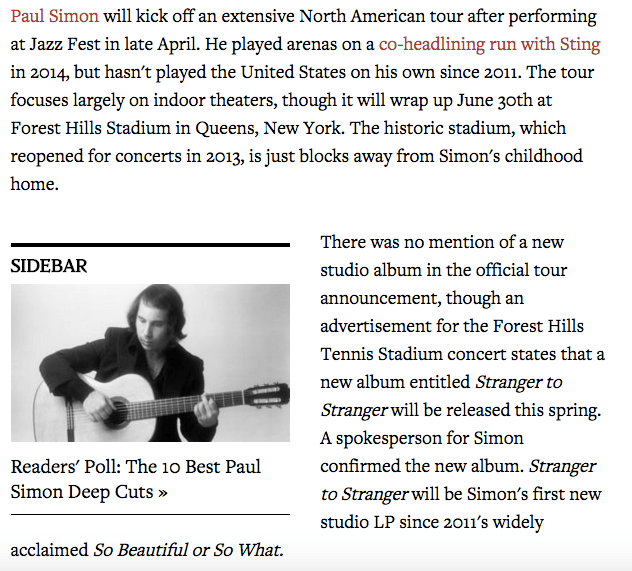
When Simon first came to England in the spring of 1964, he was still just a budding singer-songwriter, only 22 years old. Along with school friend Artie (later Art) Garfunkel, he had tasted very early American success with the gauche 1957 singleHey, Schoolgirl (released under the pseudonym Tom & Jerry), a hit when the boys were just 16. Subsequent Tom & Jerry singles had failed to sell, and nor had a scattering of other 45s Simon had released under names such as Jerry Landis, Paul Kane, True Taylor and Tico & The Triumphs.
Only the last of these efforts, coupling an early version of He Was My Brother withCarlos Dominguez, had come out in the UK, as a 1964 Jerry Landis single on Oriole. The first time most British fans would hear any of this early work would be when budget label Pickwick compiled ten tracks on a deceptively designed Simon & Garfunkel album, released to cash in on their success later in the 1960s.
Scoring a deal with Columbia, Simon and Garfunkel had reverted to their proper names and recorded their debut album, Wednesday Morning, 3AM, before Simon left for England. It wouldn’t be released until October 1964, and then in the US only, where it initially flopped. So the Paul Simon playing the English folk circuit during his first, 1964, visit was an unknown figure, certainly when his New Inn appearance took place.
 By 1965, however, Simon’s fortunes were changing. Back in England following the failure of Wednesday Morning, 3AM at home, a growing reputation in the nation’s clubs and guest appearances on BBC radio’s religious programmeFive To Ten had convinced Columbia’s UK division CBS to record his debut solo album, The Paul Simon Songbook. Featuring new recordings of Wednesday Morning, 3AM tracks The Sound Of Silence and He Was My Brother, the album also included several songs that would later find their way into the Simon & Garfunkel catalogue, including I Am A Rock, released as a solo single that summer and securing Simon an appearance on ITV’s hit pop show Ready Steady Go!
Monday 30 August 1965 was unusual as, for the first time, the Bank Holiday had been moved to the end of the month. “Despite August Bank Holiday falling three weeks later than usual, all signposts were this week pointing towards a busy weekend,” wrote that week’s Bexhill Observer (28 August). The De La Warr Pavilion’s other entertainment that weekend included a Saturday afternoon show from pianist Semprini and a Sunday Serenade from Jack Salisbury and His Broadcasting Orchestra. Set among such light fare, pop fans had to make do with The Beatles’ film Help!, screening for one week only at the Playhouse cinema.
“Monday evening’s Folk Music Festival on the terrace,” the Observer continued, “should attract a goodly number of admirers between 7.30 and 11pm. If wet, the event will be staged at the Athletic Club. The programme features Texan folk singer Paul Simon.” Getting Simon’s geographical origins wrong was not the Observer’s fault, it was simply relaying the same mistake from the De La Warr’s own advert that ran the week before (“From Texas, U.S.A., ‘Ready, Steady, Go’ etc. Single release, I’m a Rock”). The De La Warr advert did helpfully break down the rest of the day’s bill of Shirley Collins (“Sussex-born guitarist. Popular Recording Star. Appears with Davy Graham”), Ian Russell (“Popular Folk Singer of Irish, Scottish, English and American songs and satirical numbers”), Ralph May (“Blues guitarist. Recently returned from Greece”) and Rob Edwards (“Frequent visitor to Bexhill F.C. Just back from Europe”).
In a video interview for the RockHistory website, Hastings-born Collins remembers the festival with typical good humour. “He was bottom of the bill at the De La Warr Pavilion in Bexhill-on-Sea. I was ‘Shirley Collins: Britain’s versatile young instrumentalist’ – well, you know, I could play three or four chords on a banjo and guitar! But Paul Simon, bottom of the bill, I didn’t think much of him! Didn’t reckon he’d do very well!”
Collins recalls her guitarist collaborator Davy Graham, with whom she had recorded the influential album Folk Roots, New Routes in 1964, more fondly. Speaking to The Quietus’ Ben Graham this year, she says, “Davy was the originator of it all; he was the founder of it. And nobody was as good as him, really. He really was a genius I think. You can’t call many people that but you can call Davy it. Just marvellous music. Such a sweet nature, such a sweet bloke.”
Simon was also impressed by Graham’s guitar work, later covering his Anji on Simon and Garfunkel’s comeback album Sounds Of Silence and repurposing the tune on the same record’s Somewhere They Can’t Find Me. Further influences from the English folk revival crept into the duo’s work when they interpreted the traditional balladScarborough Fair on follow-up album Parsley, Sage, Rosemary and Thyme. Simon had learnt the tune from Martin Carthy, who played the De La Warr himself quite recently (it features on Carthy’s 1965 debut) and Columbia’s crediting of the tune to the New York duo caused a rift only publicly healed when Simon invited Carthy to perform it onstage with him at the Hammersmith Apollo in 2000.
He may not have impressed Collins but Simon was nothing if not ambitious. Speaking to journalist Laura Jackson, author of 2002 book Paul Simon: The Definitive Biography, Geoff Speed, then promoter of Widnes’ Howff Folk Club and later a presenter of BBC Merseyside’s Folkscene, tells how “He told [Speed’s partner] Pam that if he had not made a million pounds by the time he was 30, then he would consider that he had failed. And he didn’t say it with any bravado. It was just matter of fact.”

Simon played the Howff on 13 September 1965, a fortnight after his appearance at the De La Warr Pavilion. Famously, he wrote one of his best-known songs, Homeward Bound, while waiting at Widnes Station and pining for then-girlfriend Kathy Chitty (subject of several of his songs and cover star of The Paul Simon Songbook) back in London. A plaque commemorating this claim to fame is now displayed on the Liverpool-bound platform of Widnes railway station.
Even as his songwriting was moving forwards, the same date saw something happen back in the US that was out of his hands but would alter the course of his life: the release of a remixed version of The Sound Of Silence that producer Tom Wilson had created in his absence.
Simon and Garfunkel’s original recording of the song had begun picking up belated airplay and Wilson, sensing the shift from folk music to the folk-rock sound of The Byrds and the newly electrified Bob Dylan (both Columbia label mates of the duo), had brought in Dylan’s backing band to add overdubs to the track, including drums. Simon was performing shows on the continent when news of the single’s success reached him. Settling his affairs in England, he flew home to the States to re-establish their partnership.
While not as ground-breaking as his later collaborations with musicians from Africa (on Graceland, 1986) or South and Central America (The Rhythm Of The Saints, 1990), Paul Simon’s English visits found him absorbing influences from traditions outside of the rock’n’roll and Greenwich Village folk scenes of his New York upbringing. It was the start of an interest in global sounds that would sustain the rest of his career.
This article is from the July/August 2015 edition of The Stinger, Hastings’ free music magazine. Copies can be picked up at diverse retail outlets and venues across town. In the latest issue managing editor Andy Gunton promises readers that future issues will all be at least 48 pages long.


 Paul Simon - 'Time it was...it was'