Paul Simon Confronts Death, Profoundly, on ‘Seven Psalms’
The 81-year-old songwriter ruminates on mortality, faith and meaning in an album that could be a farewell.
What do songwriters do when they feel death approaching? As time runs out, some choose to spend it by determinedly creating music to outlive them.
“Seven Psalms” sounds like a last testament from the 81-year-old Paul Simon. It’s an album akin to David Bowie’s “Blackstar” and Leonard Cohen’s “You Want It Darker,” which those songwriters made as mortality loomed; they each died days after the albums were released.
Their generation of singer-songwriters has dedicated itself to chronicling their entire lives, biographically and metaphorically, from youth through last words. “Blackstar” was turbulent and exploratory; “You Want It Darker” was stoically bleak. “Seven Psalms” stays true to Simon’s own instincts: observant, elliptical, perpetually questioning and quietly encompassing.
The album is constructed as a nearly unbroken 33-minute suite, nominally divided into seven songs that circle back to recurring refrains. It has places of lingering contemplation and it has sudden, startling changes; its informality is exactingly planned.
Simon begins the album in his most casual tone. Over calmly precise and rhythmically flexible guitar picking, he sings, “I’ve been thinking about the great migration.”
Almost immediately, it becomes clear that the migration is from life to death, a transition the singer is preparing to make himself. He’s thinking about time, love, culture, family, music, eternity and God, striving to balance skepticism and something like faith. “I have my reasons to doubt/A white light eases the pain,” Simon sings in “Your Forgiveness.” “Two billion heartbeats and out/Or does it all begin again?”
Simon’s songwriting has never been particularly religious. Over the years, he has drawn on gospel music for songs like “Bridge Over Troubled Water” and “Loves Me Like a Rock,” which bring religious imagery to secular relationships, and his 2011 album, “So Beautiful or So What,” had touches of Christian imagery — but also imagined “The Afterlife” as one last bureaucracy, where arrivals have to “Fill out a form first/And then you wait in a line.”
“Seven Psalms” is more humble and awe-struck. Its refrains return to, and work variations on, the album’s opening song, “The Lord.” As in the psalms of the Bible — which, as Simon notes in “Sacred Harp,” were songs — Simon portrays the Lord in sweeping ways: wondrous and terrifying, both protector and destroyer, sometimes benign and sometimes wrathful. The Lord, Simon sings, is “a meal for the poorest, a welcome door to the stranger.” Then he turns to naming 21st-century perils: “The Covid virus is the Lord/The Lord is the ocean rising.”
Much of the music sounds like solitary ruminations: Simon communing with his guitar, which has been the subtly virtuosic underpinning of most of his lifetime of songs. As his fingers sketch patterns, he latches onto melody phrases and then lets them go, teasing at pop structures but soon dissolving them. And around him, at any moment, sounds can float out of the background: additional supportive guitars, the eerie microtonal bell tones of Harry Partch’s cloud-chamber bowls, the jaunty huffing of a bass harmonica and, in the album’s final moments, the voice of his wife, Edie Brickell.
In the course of the album, Simon sings about personal distress and societal tensions. In “Love Is Like a Braid,” a song of gratitude and vulnerability, he sings, “I lived a life of pleasant sorrows until the real deal came/Broke me like a twig in a winter gale.” In “Trail of Volcanoes,” he juxtaposes youthful exploits with adult realities: “The pity is the damage that’s done/Leaves so little for amends”
Meanwhile, Simon’s tartly aphoristic side reappears in “My Professional Opinion,” a swipe at social media context collapse set to a country-blues shuffle. “All rise to the occasion/Or all sink into despair,” he sings. “In my professional opinion/We’re better off not going there.”
He ends the album — possibly his last — with a song called “Wait.” He protests, “My hand’s steady/My mind is still clear.” Brickell’s voice arrives to tell him, “Life is a meteor” and “Heaven is beautiful/It’s almost like home.” At the end, he harmonizes with her on one word, extended into five musical syllables: “Amen.” It sounds like he’s accepting the inevitable.
Paul Simon
“Seven Psalms”
(Owl Records/Legacy Recordings)
Jon Pareles has been The Times’s chief pop music critic since 1988. A musician, he has played in rock bands, jazz groups and classical ensembles. He majored in music at Yale
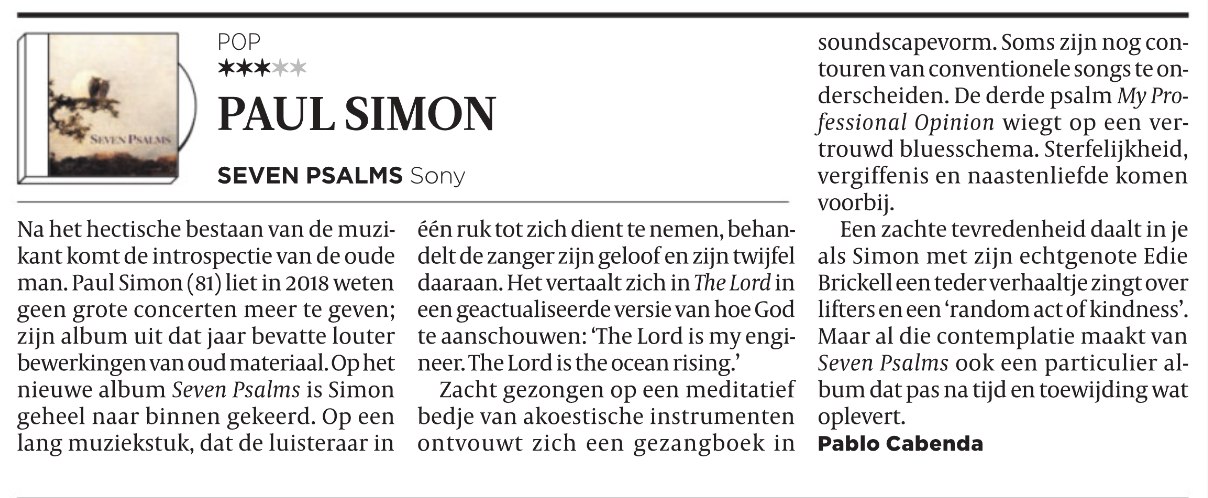
 Paul Simon - 'Time it was...it was'